Reward Systems - Money and More

Reward Systems - Money and More

What is Money ? An oversimplified view of the economic system goes like the following: When Fed increases the money supply, it means banks can now lend more money so loans are provided at a lower rate of interest to companies and people. A common depiction in pop culture is Powell going brrr with the money printer. When Fed reduces the money supply through Quantitative Tightening, banks find it harder to lend money and thus provide loans at a much higher rate. Meme: Money printer going brrrr during 2020 ...

April 11, 2024 · 8 min · 1548 words · Cheese-Cracker (Chinmay Hebbar)
Discrete Vs Continuous

Discrete Vs Continuous

Introduction In this post, we delve into the mental model (or abstract feeling) of things being continuous Vs discrete. In the direction of continuous vs discrete ideas, we look into signal processing, numerical methods and random ideas. ...

January 26, 2022 · 8 min · 1673 words · Cheese-Cracker (Chinmay Hebbar)
Computational Geometry

Computational Geometry

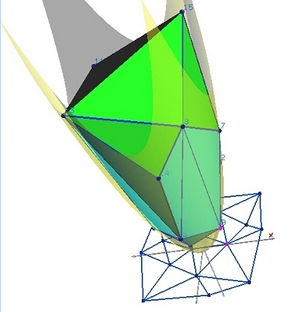
Key Resources Textbook: Computational Geometry - Algorithms and Applications Coursera Course: For the Problemset and Implementations (Till Part 5) Philipp Kindermann’s Lectures Series (Part 6 and Onwards) Various Random Resources found on the internet! Geom Algorithms CP Algorithms Further Reading / Interesting Resources ObservableHQ - Infinity and Back Again: Voronoi Diagrams for Infinite Polygons Book: Foundations of Multidimensional and Metric Data Structures - Hanen Samet (2006) Josh Hug’s Lectures on Multidimensional Data: Good intuition on k-d trees and quad trees. TestGen: Voronoi Diagrams and Delaunay Tetrahedralizations for 3D Points. Software Generalization of Voronoi Diagrams: Originally from a book on (Geometric Data Structures for Computer Graphics, 2005) Overview To learn computational geometry, these are the steps/resources I used, ...

October 1, 2020 · 26 min · 5506 words · Chinmay H

Numerical Analysis

Resources Jacob Bishop’s Tutorials Part 5-7 covers most topics Gauss Quadrature Vs Newton Cotes’ Visualization Check Calculator function input for Iterative Approximation Methods( Newton-Rhapson, Fixed Point Iteration etc.) Basic Analysis Catastrophic Cancellation Significant Digits Vs Decimal points Sum for minimal error, rounding/chopping Taylor Series’ Approximation and Error Iterative Methods Bisection Regula Falsi (Method of Chords) Secant Swap to whichever is close Fixed Point Iteration Order of convergences Uniqueness Error Analysis Newton Raphson Order of convergences Matrix Techniques Pivoting (Partial Pivoting = Every Step) Scaling First before Pivoting Matrix Norms Norm_1(A) = max(col sum) Norm_inf(A) = max(row sum) Norm_2(A) = Spectral Norm = $\sqrt \lambda$ for eigenvalue Norm_F(A) = root of(Sum of all a_ij^2) = Frobenius Norm Conditional No. = ||A|| * ||A^-1|| Matrix Iterative Methods In order to solve, systems of equation we have Gauss-El-M, Gauss-Jacobi and Gauss-Siedel. Jacobi and Siedel is mostly used for sparse arrays where G-El-M is highly ineffecient. Newton-Raphson, Fixed Point are iterative methods also work while finding solution. ...

January 20, 2020 · 3 min · 494 words · Chinmay H

Math Modelling

Important Topics Routh Hurwitz Test Matrix of Variation/Jacobian of dx/dt (and dy/dt) Stability of solution Local Stability (Matrix of Variation) Eigenvalues Positive Definate : Unstable Negative Definate : Local AS Imaginary Eigenvalues: Spiral Global Stability (Appropriate Lyaponov Function) Test stability by Lyapunov Funcn or any other (V) has derivative negative definate $$V(x) = x - x^* - x^* ln(\frac{x}{x^*}) \frac{k_1}{2}(T- T^*)^2 + \frac{k_2}{2}(U-U^*)^2$$$$\frac{dV}{dt} = \frac{\dot{x}}{x}( x - x^*) + other$$ Quick Finding of Eigenvalues (see Prerequisites) Complex Eigenvalues and Calculation of Spiral Linearization of Solution Logistic regression Model $$ \frac{dx}{dt} = rx(1 - \frac{x}{k})$$ Persistance / Permanance of Solution Picard-Landlof Theorem - Existence of Solution Sylvester’s Criteria - b^2 - 4ac conditions Hamiltonian $$ H(x, t, u, \lambda) = g*{divident}(x, t, u) + \lambda f*{capital\ assets}(x, t, u) $$ Pontrayagin’s Maximum Principle $$ \frac{d\lambda}{dt} = -\frac{dH}{dx}$$ Bang-Bang and Singular Control (Control Theory) De Carte’s Rule of Sign Dulac Bendixson Criteria for periodicity of soln Bionic Equilibrium Conditions (for Optimal Harvesting) Hopf Bifurcation: The point where behavior of system stability changes. Opposite stability before and after critical value. Lebesgue Cycle Stability Basic Reproduction No. LimSup Method for showing boundedness Standard Comparison Theorem, Amax > Bmin, well-posedness … Models Malthusian Growth Model $$ dx/dt = rx$$ Logistic Growth Model (inter-specific interference) Resource-Consumer and similar models - Prey-Predator Model (or Resource Consumer) specialized prey-predator generalized prey-predator Competetive Model Cooperation Model 3 Species Food Chain Model (Logistic Growth with interspecie interface) Opimal Harvesting (fish) Model - Max Sustainable Yield Migration of Fishes Model Pollution Toxicant Models- 2D Model 3D Model - Uptake of Conc (POST-Midsem) Susceptible-Infected and variant models SI Model SIS Model(with immunity) SIR Model(with complete cure forever) SEIR Model(Both Exposed and Recovery types) Analysis of Solution Boundedness Positivity and Solution Space $\Omega$ Persistance of Solution (Show Lower Bound) Periodicity or not (Dulac Bendixson Criteria) Equilibrium Points Local Stability Analysis Linearize solution and then find values OR… Use generalized matrix of variation and plug in values Global Stability Analysis Choose Lyapanov Function and terms based on Logistic Growth or not Differentiate and show Negative Definate Use Sylvester’s Criteria and compare terms using Routh-Hurwitz Criteria Routh Array to show stability Other Analysis Techniques Rate $\dot{r}$ for growth and $\dot{\theta}$ for clockwise/anticlockwise in spirals Lebesgue Cycle stability in spirals Critical points in Hopf Bifurcation and stability chart Basic Reproduction Number Calculation Sample Model to check equilibrium points graph TD A[Formulate the Rate Diffn Equations] --> AB AB[ Find Omega. Check if bounded with limsup and show positive also. Check Persistance/Periodicity] --> B B[Find equilibrium points where rate = 0] --> C C[Local Stability. Get matrix of variation/Jacobian at these points] --> D C --> E[Get Char Eqn with Eigenvalue] E --> F[Use Routh Hurwitz to get roots' sign] F --> G[From sign of eigenvalues determine stability of Local Solution] D[Get Eigenvalues of the matrix of variation] --> G G --> H H[Global Stability. Use Lyapunov function variants Derivative] --> I[Check if negative definate by adding/subtracting] Harvesting Model Sample Flow Steps for Solving ...

May 20, 2019 · 4 min · 810 words · Chinmay H
Principles of Economics

Principles of Economics

Introduction These are my notes for POE. The notes were written using markdown and vim (see iamcco/markdown.nvim plugin) and Pandoc (with eisvogel template). Feel free to collaborate to the Online Version of POE Notes. These are only supplementary notes and NOT Lecture Notes. Some useful resources. ...

May 20, 2019 · 11 min · 2216 words · Chinmay H

Graphs and Networks

List of Algorithms Minimum Spanning Trees Krusikal’s (Any point but min with no cycle) Prim’s (From starting point) Graph Traversal Techniques BFS DFS Djkstra’s Shortest Path Apply DFS for checking cut vertex Eulerian/Hamiltonian Graphs ...

March 10, 2019 · 5 min · 954 words · Chinmay H